
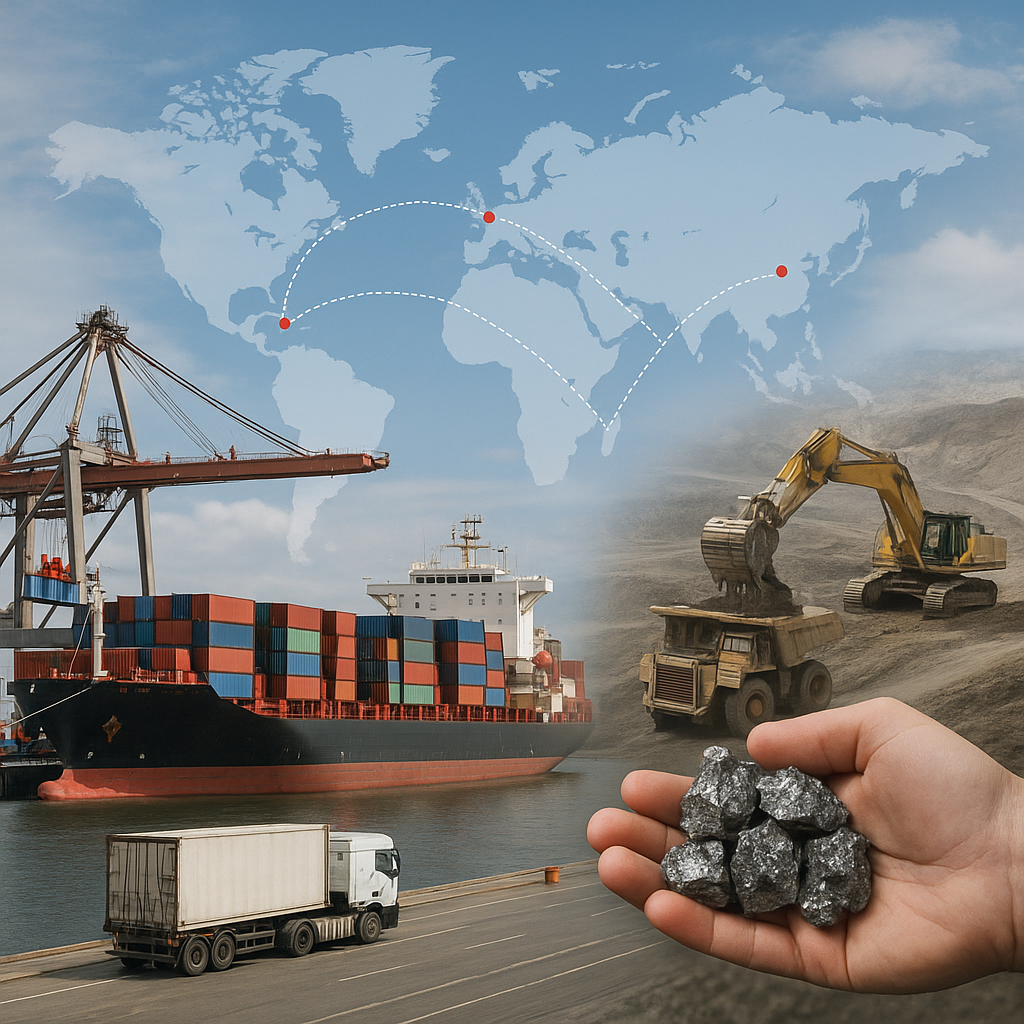
Global supply chains of rare earth elements have become a strategic concern for governments, investors and manufacturers across the world. These 17 metallic elements are essential for high‑tech electronics, defence systems, renewable energy and advanced automotive components. At the same time, production and processing are heavily concentrated in just a few countries, making the entire chain vulnerable to geopolitical shocks, trade disputes and environmental regulation. As markets react to these risks, currency volatility, trade balances and investment flows increasingly intersect with rare earth supply issues, a trend followed closely by platforms such as foreignexchange.kim. Understanding how these materials are mined, processed, traded and recycled is now critical not only for industrial planners, but also for financial analysts and policymakers seeking to build resilience and strategic autonomy.
What are rare earth elements and why they matter
Rare earth elements (REEs) are a group of 17 metals, including the 15 lanthanides plus scandium and yttrium. Despite the name, they are relatively abundant in the Earth’s crust, but economically viable deposits are less common and often difficult to exploit. Their real importance arises from unique magnetic, luminescent and catalytic properties that make them indispensable in many advanced technologies.
Permanent magnets based on **neodymium**, dysprosium and praseodymium are used in high‑efficiency electric motors, wind turbine generators and hard disk drives. Europium and terbium enable vivid colours and energy‑efficient displays in smartphones, televisions and LED lighting. Cerium and lanthanum play a crucial role in catalysts for petroleum refining and automotive exhaust systems. Because even small quantities of REEs can dramatically improve performance, there are often no easy substitutes without sacrificing efficiency, size or durability.
From a strategic perspective, REEs underpin multiple sectors: renewable energy, electric vehicles, consumer electronics, aerospace, defence and telecommunications. The result is a strong link between **critical minerals** policy, industrial competitiveness and national security. Disruptions in supply can ripple across manufacturing chains, influence trade balances and affect the bargaining power of states in global negotiations.
Geographical concentration of resources and production
Geologically, rare earth deposits are distributed worldwide, including in China, the United States, Australia, Brazil, India, Russia and several African countries. However, the current supply chain is highly concentrated at two critical stages: primary mining and especially processing and separation. This concentration creates systemic vulnerability and gives key producers substantial leverage.
China has long dominated REE production, at times providing over 60–70% of global mine output and an even larger share of processing capacity. Several factors explain this dominance: large deposits such as Bayan Obo in Inner Mongolia, supportive industrial policy, state‑backed investment in refining technologies and a willingness to accept significant environmental costs. Over decades, this allowed Chinese companies to build extensive know‑how and achieve economies of scale.
Outside China, the United States (notably the Mountain Pass mine), Australia and a growing number of projects in Canada, Africa and South‑East Asia are attempting to diversify supply. Yet many of these mines still ship concentrates to Chinese processors because of limited domestic separation and refining capacity. This asymmetry means that even when ore is mined elsewhere, value creation and strategic control often remain concentrated in Chinese hands.
Stages of the rare earth supply chain
The global supply chain of rare earth elements can be divided into several stages, each with its own technical challenges, capital requirements and risk profile. Understanding these stages helps explain why diversification has been slow and complex.
First, exploration and resource assessment require detailed geological surveys, drilling and sampling to identify economically viable deposits. Because rare earths typically occur with other elements and often at low concentrations, extensive analysis is needed to evaluate potential profitability. Regulatory approvals, land access and community engagement add time and uncertainty to this phase.
Second, mining and beneficiation involve extracting the ore and concentrating it through crushing, grinding and physical or chemical separation. These processes generate large volumes of waste rock and tailings, often containing radioactive elements such as thorium and uranium. Managing these materials safely is costly and can face strong public resistance.
Third, chemical processing and separation represent the most technically demanding part of the chain. Individual rare earths have very similar chemical properties, so separating them into high‑purity oxides or metals requires complex solvent extraction, ion‑exchange or other advanced techniques. This stage is capital intensive, energy intensive and associated with potentially severe environmental impacts if not properly controlled.
Finally, downstream manufacturing transforms separated rare earths into functional materials, such as magnets, phosphors, catalysts or polishing powders. These materials are then integrated into components and final products. The further one moves downstream, the higher the value added and the greater the importance of industrial know‑how, intellectual property and customer relationships.
Environmental and social dimensions
The environmental and social footprint of REE mining and processing has become a central concern. Traditional operations have generated significant air and water pollution, radioactive waste and long‑term land degradation. Inadequate waste handling and weak oversight in some regions have damaged local ecosystems and public health, prompting calls for stricter regulation and responsible sourcing.
Communities near rare earth projects often face trade‑offs between economic opportunities and environmental risks. Employment, infrastructure and tax revenues can bring development, yet pollution, water consumption and land disturbance may threaten agriculture and traditional livelihoods. Social licence to operate is therefore a critical asset, requiring transparent communication, fair benefit‑sharing and effective environmental monitoring.
As consumers and investors increasingly focus on sustainability, pressure is mounting on companies to demonstrate **responsible** practices across the entire supply chain. Environmental, social and governance frameworks, life‑cycle assessments and certification schemes are emerging tools to differentiate producers based on performance. In the long run, projects that invest in high standards may gain competitive advantage as regulators and customers tighten requirements.
Geopolitics and strategic vulnerability
The concentration of rare earth production has transformed these materials into instruments of geopolitical leverage. Export restrictions, tariffs or informal controls can quickly disrupt downstream industries worldwide. Past incidents, in which supply constraints coincided with diplomatic tensions, highlighted the strategic nature of these metals and triggered policy responses in many capitals.
Countries dependent on imported REEs, particularly for defence and high‑tech sectors, increasingly treat them as **strategic** commodities. Stockpiling, investment in domestic projects and diversification of trade partners have become part of broader industrial and security strategies. Trade agreements and diplomatic initiatives now often include provisions related to critical minerals, reflecting their importance for economic resilience.
This strategic dimension interacts with global finance and currency markets. Changes in rare earth policies can influence investor sentiment, shape expectations for future industrial competitiveness and affect the valuation of companies involved in the sector. While the market size of REEs is modest compared with bulk commodities, their role in high‑value industries amplifies their macroeconomic significance.
Efforts to diversify and build resilience
In response to perceived over‑reliance on a single dominant supplier, governments and companies are working to diversify supply chains. New mining projects in North America, Australia, Africa and Europe aim to develop alternative sources, often with strong state support. Public funding, loan guarantees and streamlined permitting processes are being used to reduce risks for private investors.
Diversification, however, is not just about new mines. Building processing and separation capacity outside existing hubs is essential if countries wish to capture more value and reduce vulnerability. This requires coordinated investment in infrastructure, skilled labour, research and development and long‑term offtake agreements with manufacturers. Without reliable demand, expensive processing plants may struggle to achieve economic viability.
Another pillar of resilience is the development of recycling and urban mining. End‑of‑life electronics, magnets and batteries contain significant quantities of rare earths, though collection and separation remain challenging. Advances in hydrometallurgical and pyrometallurgical recycling technologies are beginning to make recovery more feasible. Over time, a robust recycling sector could reduce pressure on primary resources and provide a more geographically diffuse source of supply.
Technological innovation and substitution
Innovation offers additional pathways to mitigate supply risks and environmental impacts. One approach is to reduce the intensity of rare earth use in existing applications. Engineers work on magnet designs that achieve the same performance with less neodymium or dysprosium, or on motors that cut REE content through improved efficiency. Incremental gains across millions of devices can significantly lower aggregate demand.
Another strategy is the development of alternative materials that can partially or fully replace certain REEs. For instance, ferrite or alnico magnets can substitute in some contexts, though often at the cost of greater weight or lower performance. Research in nanomaterials, high‑temperature superconductors and other advanced materials aims to provide more competitive substitutes over time.
Digital technologies, such as data analytics and automation, also contribute to more efficient mining and processing. Better ore characterization, real‑time monitoring and optimized chemical circuits can increase recovery rates while reducing waste and energy use. These improvements not only enhance profitability but can also help meet stricter environmental standards.
Economic and financial aspects of rare earth trade
Although the rare earth market is relatively small in dollar terms compared with oil, gas or iron ore, its economic implications are disproportionate to its size. REE prices have historically been volatile, driven by policy changes, trade disputes, speculative behaviour and shifts in downstream demand such as electric vehicle adoption. Price spikes can encourage over‑investment, while subsequent corrections may render new projects uneconomic.
For producing countries, rare earth exports can support trade balances, create high‑value jobs and stimulate broader industrial development. However, dependence on a narrow set of commodities also exposes economies to demand and price cycles. Some governments seek to move up the value chain by promoting domestic manufacturing of magnets, batteries and other components, rather than exporting raw materials or simple concentrates.
For importing regions, secure access to REEs is tied to industrial policy, innovation capacity and energy transition targets. Electric vehicles, wind power and advanced electronics all compete for similar materials, raising questions about allocation and long‑term affordability. Financial markets monitor these dynamics as indicators of potential bottlenecks and investment opportunities across mining, processing and clean technology sectors.
Future scenarios for global supply chains
The future of global rare earth supply chains will likely be shaped by three broad forces: geopolitical competition, climate policy and technological change. If strategic rivalry intensifies, states may pursue more aggressive industrial strategies, including export controls, investment screening and support for domestic producers. Such moves could fragment markets, increase costs and slow the diffusion of clean technologies.
Conversely, coordinated approaches focused on transparency, environmental standards and shared investment in innovation could foster a more stable and sustainable system. International partnerships on critical minerals, common reporting frameworks and joint research programs may reduce mistrust and open new avenues for cooperation. Regional value chains could emerge that balance resilience with economic efficiency.
At the same time, rapid progress in recycling, **efficiency** improvements and material substitution could change demand patterns significantly. If electric vehicle and renewable energy technologies evolve to rely less on the most constrained rare earths, pressure on certain segments of the chain might ease. Yet new applications, from quantum technologies to advanced sensors, may create fresh demand for other elements, keeping rare earths at the centre of strategic planning.
Conclusion
Global supply chains of rare earth elements sit at the intersection of technology, environment, economics and geopolitics. Their unique properties make them vital for high‑performance devices and the low‑carbon transition, while their concentrated production creates structural vulnerabilities. Efforts to diversify supply, improve environmental performance and innovate in materials science are reshaping the landscape, but significant challenges remain.
For governments, building resilience will require balanced strategies that combine domestic development with international cooperation. For companies, securing reliable access and demonstrating **sustainability** across the value chain will be central to competitiveness. As the world moves deeper into an era defined by digitalization and decarbonization, the evolution of rare earth supply chains will continue to influence industrial policy, financial markets and the broader architecture of the global economy.

Leave a Reply